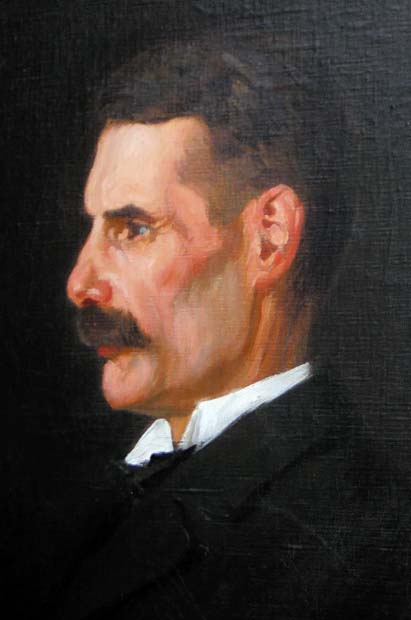
Shan Bullock
Shan Bullock was an acclaimed writer from the 1890s onwards, though the acclaim was not matched by sales and he spent most of his life working for the Civil Service in London. In 1901 The New York Times described Bullock as “one of the leaders in the modern Celtic literary movement.”
John William Bullock was born in 1865 in Inisherk, County Fermanagh. He was the son of Thomas Bullock, steward of the Earl of Erne’s Crom estate. After failing the entrance exam for Trinity College, Dublin, John Bullock briefly, and unhappily, tried farming before moving to London in 1883 to become a civil service clerk in Somerset House. Taking the pen name Shan Fadh from the William Carleton story Shane Fadh’s Wedding Bullock supplemented his civil service income through literary journalism (he was the London literary correspondent for the Chicago Evening Post for twenty years).
Bullock’s short stories were published widely in magazines such as The Outlook and The British Monthly, as well as George Russell’s The Irish Homestead. He published prolifically, including 14 novels and 3 collections of short stories, but his writing was never successful enough for Bullock to leave the civil service.
Between 1917 – 1918 Bullock performed secretarial duties, at the request of Sir Horace Plunkett, to the Irish Home Rule Convention, which was established to discuss self-government for Ireland, and was awarded the MBE for his role with the Convention.
Bullock’s wife died in 1922, and disillusioned by the violence of the Irish War of Independence he feared that the order maintained by the older generation was being lost. This fear was expressed in his final novel, The Loughsiders (published in 1924). In 1933 Bullock was made a member of the Irish Academy of Letters, after the death of George Moore, which he regarded as the greatest honour of his life. He died in 1935.

In 1903 the Irish newspaper The United Irishman described Bullock’s writing as “the finest Ulster — maybe the finest Irish — stories of this generation”.